Showing posts with label St. Michael Indian School. Show all posts
Friday, May 15, 2015
Giving Out Books on the Navajo Nation
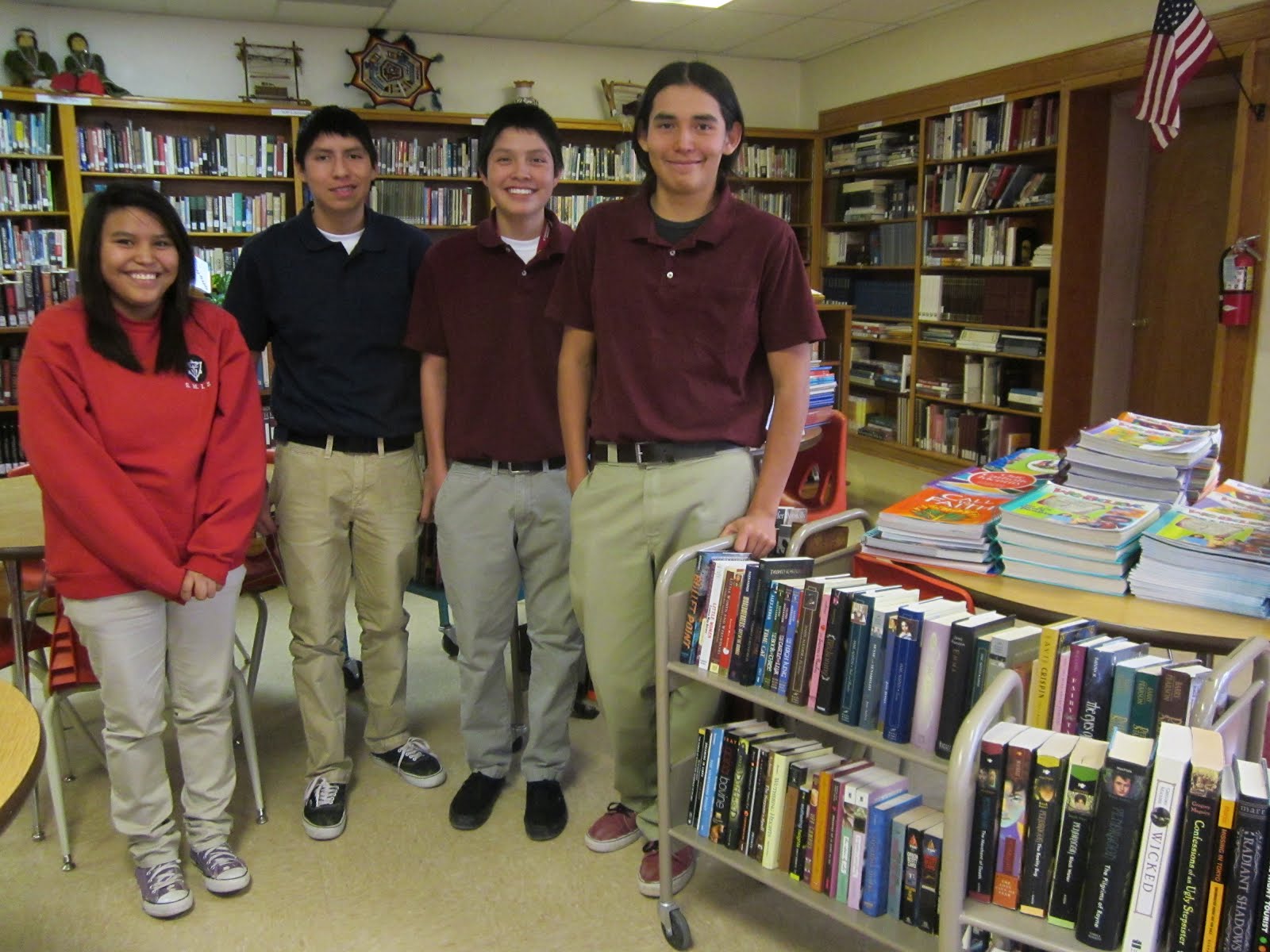
St. Michael High School students in St. Michaels, Arizona (the capital of the Navajo Nation). were thrilled that they could each take home a few books donated by Reader to Reader today. One student told me how excited she was to have something to read over the summer, since she loves reading and was almost out of things to read. A group of freshmen traded book recommendations and bargained with each other over who could borrow which book in what order. Another student was very excited to take home a beautiful book of photos from National Geographic. A student who just returned from a mission trip to the Philippines chose to take home "Mountains Beyond Mountains," about Dr. Paul Farmer's efforts to provide health care in Haiti.
Monday, February 23, 2015
St. Michaels Students Take College Discovery Class
Meg Holladay, our hard-working Navajo Outreach Coordinator, is teaching a College Discovery class at St. Michael Indian School in St. Michaels, Arizona.
Pictured above are students practicing a full-length practice ACT exam Reading section. Test scores have improved dramatically thanks to her work.
The Navajo Outreach
Program is funded in part by the Fordham Street Foundation and the Hiatt Family
Foundation.
Wednesday, December 3, 2014
Practice Makes Perfect at St. Michael Indian School
On Nov. 22, 12 students came to St. Michael's Indian School in St. Michaels, Arizona, on a Saturday morning to take a full-length practice ACT under the watchful eye of Reader to Reader’s Navajo Outreach Coordinator, Meg Holladay. We started bright and early at 8AM, the same time the real ACT begins, and the students worked hard on the test until around noon. Eight students chose to write the optional essay section of the test. After time was up, we graded the practice tests together. Students were able to compare their scores to the national averages, and see which sections were going well for them and which they needed to improve. Many told us it was a valuable experience for them, and everyone went home to a well-deserved weekend of rest!
Monday, November 10, 2014
St. Michael Students Learn About College Through Panel Discussion
Last week at St. Michael High School in St. Michaels, Arizona, our Navajo Outreach Coordinator, Meg Holladay, organized a panel discussion of five teachers talking about their experiences in college. This was part of Blueprint for Success, a college-exploration activity that Reader to Reader is running at SMHS.
Students are very
curious about college: what's it like to be there? Are professors mean? Is it
hard to live with a roommate? Through this panel, teachers were able
to tell their college stories. About 25 students, mostly juniors,
came during their lunch period to hear them.
The teachers who
volunteered to be on the panel had all had very different college
experiences. They had attended Penn State, Notre Dame, the University of New
Mexico, New Mexico State and the University of Colorado, and Georgian Court
University (a small women's college in New Jersey). They had majored in fields
as diverse as biology, English, education, and the history of ideas.
Here is Meg’s report
on the discussion.
I asked the teachers
four questions:
How did you choose
your college? When you got there, was it the way you expected?
One teacher said she
hadn't expected to like a women's school, and her heart had been set on another
college, but when she visited Georgian Court, it felt like a family and
she fell in love.
What part of college
was the hardest for you, and what was the most fun?
As the hardest part of
college, several teachers mentioned social life: getting to know a new set
of people, making friends, a divide between Native and non-Native students
at UNM. Another teacher talked about trying to balance academics and social
life. One teacher said that the intellectual exploration he did in college was
the most fun part; another mentioned an English majors' club that organized
events like bonfire poetry readings, and another talked about being a mentor
for younger students.
What was your single
favorite class and why?
One teacher said that
her hardest biology class in college, a class in which she'd spend whole days
studying, was also her favorite. Several students were incredulous that her
favorite was such a hard class. Another teacher told the students about a
child-development class in which he was the only man, and many of the women in
the class were his grandmother's age--he said he got in touch with the part of
himself that says "awww" at pictures of babies.
What part of college
has most impacted your life today?
One teacher talked
about the writing skills he gained, and how they've been applicable in many
more places than he thought they would be. Others talked about social and
intellectual skills.
Then we opened up the
discussion to student questions. Students asked the teachers what they had
written their application essays about, how much writing they had had to do in
college, and what they had been afraid of that had turned out okay.
I think that everyone,
including myself, left with a better idea of the range of experiences a person
can have in college.
Thursday, October 9, 2014
At Work on the Navajo Nation
We are so pleased to welcome Carleton College graduate Meg Holladay as
our new Navajo Outreach Coordinator.
Meg is based on the Navajo Nation in St. Michaels, Arizona, where she is bringing
a host of services and programs to area schools.
Through our Blueprint for Success Program, she is helping students with
ACT and SAT test prep, college search, college applications, essay writing, and
financial aid support.
She is also a resource connector, helping Reader to Reader meet the needs
of a wide variety of groups across the 27,000 square-mile Navajo Nation.
Tuesday, February 11, 2014
Reader to Reader Helps ACT Scores Improve on the Navajo Nation!
Ophelia Hu, Reader to Reader's Navajo Nation Outreach Coordinator, describes the process of teaching SAT prep to seniors at St Michael’s Indian School this year.
We began class ten chairs short and in stifling heat last August in St. Michaels, Arizona. Our task: to improve the ACT scores of St. Michael Indian School's entire senior class with only 250 minutes per week.
For our second year in a row, ACT scores at St. Michael have remained over 1% above the national average, which is a drastic improvement from its standing of over 25% below that average before Reader to Reader began its College Readiness programs at the school.
But the applause certainly doesn't belong to Reader to Reader alone. The accolade belongs to the senior class, who toiled every day, attended optional practice tests in the evenings and on weekends, and achieved impressive personal score improvements. Reader to Reader also provided each student with a free, new copy of an ACT textbook, and both instruction and homework helped students to excel on the test.
I had the privilege of getting to know the remarkable Class of 2014. We worked hard. Not every day was fun. From time to time, students would call in the middle of the night asking for clarification with a concept or to vent about test anxiety. But between recovering math skills and summarizing dense science articles, we had our share of good times, too.
At the end of the course, each senior wrote a letter to the Class of 2015 with their personalized advice for senior year, college readiness, and ACT prep.
The continued success of students at St. Michael shows that all students have a remarkable capacity to grow and learn. We are honored to be a part of that process, and we look forward to getting even more students to take the reins on their future.
Reader to Reader’s Navajo Outreach Coordinator is funded through the generous support of the Fordham Street Foundation, the Hiatt Family Foundation, and Jean and Lynn Miller.
Wednesday, January 29, 2014
Poetry Out Loud on the Navajo Nation
Students from St. Michael Indian School in St. Michaels, Arizona vied for the chance to represent their school and advance to the Northern Arizona regional competition of Poetry Out Loud (POL).
The students worked under the leadership of Reader to Reader's Navajo Outreach Coordinator, Ophelia Hu.
POL is a national poetry recitation contest that aims to keep this age-old art form alive. Students performed poetry from a pre-selected anthology of the best works of all time, but their performances were only the tip of the iceberg.
"For months, I've had the honor of working with students during Writers' Workshops and in one-on-one tutelage to understand and love poetry," Ophelia Hu said. "Students have intensely researched their poems, know the definition of every word, and can now tell you how their poet used language to convey a message. They prepared a range of nuanced messages from Emily Dickinson's darker works to the stark brilliance of Karin Gottshall and the grotesque, kaleidoscopic verses of Mina Loy.
I'm especially proud that the students have increased their ability to both give and receive constructive critiques. Even our shyest participants have grown, learned to project their voices, and taken on challenging pieces. Except for one student who received his poem the day before the competition, all competitors had their poems memorized by the night of the contest."
Last night's school contest was truly a celebration of the students' hard work. About forty people were in attendance, and two English teachers also shared prepared poetry.
"The students dazzled us with their impeccable performances and a deep understanding of poetry beyond their years."
Judging was painfully difficult. Each judge was moved by the students' sincerity of delivery and impressed by their abilities. In the end, the judges selected Meucci '17 and Janae '16 to advance to regionals, which will be held in Flagstaff, Arizona on February 8th.
"I'm so incredibly proud of these students," Ophelia Hu said. "It was nearly impossible to choose winners because I was so wowed by all the performances!"
(Reader to Reader’s Navajo Outreach Coordinator is funded through the generous support of the Fordham Street Foundation, the Hiatt Family Foundation, and Jean and Lynn Miller.)
Tuesday, May 21, 2013
15,000 Books Arrive on Navajo Nation
A huge truck rumbled up as 15,000 books completed a 5-day journey across the country to the Navajo Nation in Arizona.
The books will be distributed to schools, libraries, Boys & Girls Clubs, Head Start Programs and other areas of need across the 27,000 square-mile Navajo and Hopi reservations.
Reader to Reader staff and four Amherst College students flew to Albuquerque and drove three hours to Window Rock, Arizona to help unload the truck and deliver some of the books. The truck was driven by Navajo Nation Library officials that flew to Massachusetts to pick up the books.
The college students work during the school year in Reader to Reader’s Navajo Mentoring Program and are spending a week working with students at St. Michael Indian School in St. Michaels, Arizona.
Wednesday, March 20, 2013
Books Bring Library Expansion
Students at St. Michael Indian School in St. Michaels, Arizona clean shelving units before their assembly.
Over the past year, Reader to Reader has donated thousands of books to replenish the school’s antiquated library. At the start of the school year a second adjoining room was opened for library use, including a bank of computers that were also donated by Reader to Reader.
With the large influx of books came a need for additional shelving units. Irving Nelson of the Navajo Nation Library in Window Rock, Arizona generously donated some used shelving units that the library was not using.
A special thank you to the Navajo Nation Library for their assistance in this project.
Tuesday, January 29, 2013
ACT Scores Soar at St. Michael Indian School
(Reader to Reader’s Navajo Nation Outreach Coordinator, Ophelia Hu, reports from St. Michaels, Arizona.)
The new semester has just begun, and here in the Navajo Nation, we’re putting juniors to work studying for their ACTs. Why don’t we join them in a multiple-choice exercise?
- Which of the following represents an ACT victory for this year’s seniors at St. Michael Indian School?
A. An increase in average score from last year by 5.63 points
B. A 64% increase from last year in the proportion of seniors who took the test
C. Collectively scoring above the state and national average for the first time in three years (From 25.92% below the national average to .10% above the national average in one year!)
D. An increase in the mode (most commonly earned) score by 9 points from last year
E. All of the above
In reality, this should be an open-ended essay question, because there are many more right answers. (But the answer is E. All of the above.)
These are just numbers, and they fail to capture the totality of influencing factors, but these numbers still make me proud. Moreover, they describe the innate, not inculcated, abilities of these and countless students like them in the Navajo Nation. Too often, educators, policy-makers, and others write off academic success as an ethnic or socioeconomic prescription. And other times, they tell underserved communities that no barriers exist to their achievement, yet without the tools necessary for success that other schools have, students face daunting challenges. Then, students often believe these lies about themselves. Of course, these students’ results are the reward of their hard work, but I hope that these numbers also show the great reserves of intelligence, potential, and desire in all young people, and how even a modest investment of time and resources can awaken great abilities.
But not all of our efforts can be summarized quantitatively. How do I quantify the love for reading kindled by a long-awaited book that Reader to Reader recently donated? And the boy who returned it after reading for a day because he bought his own copy and wanted someone else to be able to check out this one? Or the gladness of librarians who receive the books Reader to Reader sends? And how do I quantify the confidence and skills gained by students working with their Reader to Reader mentors? Or the boon in our writing workshops, and how they vest student and adult writers with voices?
At our first women's writing workshop the other night, one woman wrote a deeply personal recollection and read it aloud for the first time, prompting tears and similar stories from many others. The whole event was therapeutic and trust-building for us all.
Other women spanned topics from love letters to ourselves to stories about how pets inspire us, recollections of youth, introductions of culture, etc. Every piece projected incredible beauty and hope. Our writing almost immediately cemented us strangers together in love and trust. And this was just our first meeting. Never underestimate the power of the written craft!
The blog that links student writing workshops to the women’s writing workshop should be fully functional by next week, so stay tuned for its release. Right now, we’re devising ways for our growing base of interested long-distance contacts to be involved.
To me, there is something powerful about equipping a community to tell its own stories when it has long been told that outsiders would tell its stories. And while Native Americans are often depicted as a people of the past, their words belong on a globally accessible, constantly updated platform. I hope that the blog can serve this purpose in some small way.
We’re also continuing programs at Navajo Pine and Window Rock High Schools, including college and skill-building workshops, and with the Navajo Nation’s First Lady to organize educational fairs. Soon, College Knowledge will be underway with our partnership with Dartmouth College’s Native American Program. We may also begin a network of writers’ workshops across the Navajo Nation to link writers together and broadcast their work.
This is just a slice of our activities, here. Check back soon for a link to the writers’ blog and more updates. Thank you for reading!
Cheers,
Ophelia
Funding for the Navajo Outreach Coordinator position comes in part from the Hiatt Family, the Fordham Street Foundation, John & Elizabeth Armstrong, and Lynn & Jean Miller.
The new semester has just begun, and here in the Navajo Nation, we’re putting juniors to work studying for their ACTs. Why don’t we join them in a multiple-choice exercise?
- Which of the following represents an ACT victory for this year’s seniors at St. Michael Indian School?
A. An increase in average score from last year by 5.63 points
B. A 64% increase from last year in the proportion of seniors who took the test
C. Collectively scoring above the state and national average for the first time in three years (From 25.92% below the national average to .10% above the national average in one year!)
D. An increase in the mode (most commonly earned) score by 9 points from last year
E. All of the above
In reality, this should be an open-ended essay question, because there are many more right answers. (But the answer is E. All of the above.)
These are just numbers, and they fail to capture the totality of influencing factors, but these numbers still make me proud. Moreover, they describe the innate, not inculcated, abilities of these and countless students like them in the Navajo Nation. Too often, educators, policy-makers, and others write off academic success as an ethnic or socioeconomic prescription. And other times, they tell underserved communities that no barriers exist to their achievement, yet without the tools necessary for success that other schools have, students face daunting challenges. Then, students often believe these lies about themselves. Of course, these students’ results are the reward of their hard work, but I hope that these numbers also show the great reserves of intelligence, potential, and desire in all young people, and how even a modest investment of time and resources can awaken great abilities.
But not all of our efforts can be summarized quantitatively. How do I quantify the love for reading kindled by a long-awaited book that Reader to Reader recently donated? And the boy who returned it after reading for a day because he bought his own copy and wanted someone else to be able to check out this one? Or the gladness of librarians who receive the books Reader to Reader sends? And how do I quantify the confidence and skills gained by students working with their Reader to Reader mentors? Or the boon in our writing workshops, and how they vest student and adult writers with voices?
At our first women's writing workshop the other night, one woman wrote a deeply personal recollection and read it aloud for the first time, prompting tears and similar stories from many others. The whole event was therapeutic and trust-building for us all.
Other women spanned topics from love letters to ourselves to stories about how pets inspire us, recollections of youth, introductions of culture, etc. Every piece projected incredible beauty and hope. Our writing almost immediately cemented us strangers together in love and trust. And this was just our first meeting. Never underestimate the power of the written craft!
The blog that links student writing workshops to the women’s writing workshop should be fully functional by next week, so stay tuned for its release. Right now, we’re devising ways for our growing base of interested long-distance contacts to be involved.
To me, there is something powerful about equipping a community to tell its own stories when it has long been told that outsiders would tell its stories. And while Native Americans are often depicted as a people of the past, their words belong on a globally accessible, constantly updated platform. I hope that the blog can serve this purpose in some small way.
We’re also continuing programs at Navajo Pine and Window Rock High Schools, including college and skill-building workshops, and with the Navajo Nation’s First Lady to organize educational fairs. Soon, College Knowledge will be underway with our partnership with Dartmouth College’s Native American Program. We may also begin a network of writers’ workshops across the Navajo Nation to link writers together and broadcast their work.
This is just a slice of our activities, here. Check back soon for a link to the writers’ blog and more updates. Thank you for reading!
Cheers,
Ophelia
Funding for the Navajo Outreach Coordinator position comes in part from the Hiatt Family, the Fordham Street Foundation, John & Elizabeth Armstrong, and Lynn & Jean Miller.
Tuesday, October 30, 2012
Navajo Librarian Battles Hurricane Sandy to Bring Books Back to Navajo Nation
With the winds of Hurricane Sandy hitting gusts of 50-miles-per-hour, Irving Nelson, Program Supervisor for the Navajo Nation Library in Window Rock, drove a 26-foot truck loaded with 7-tons of books through Massachusetts and Pennsylvania Monday.
Nelson is making his second trip this year to bring back over 16,000 books and a dozen computers that will be distributed to 16 schools on the Navajo Nation and Hopi reservation.
A similar trip in July brought back 15,000 books and 21 computers.
The books and computers are being donated by Reader to Reader, a Massachusetts literacy organization that has donated over $1,000,000 worth of books to the Navajo Nation in the past ten years.
A team of Reader to Reader employees and volunteers raced to load the truck, trying to beat the storm as it moved up the eastern seaboard.
“Irving Nelson is one of a kind,” said Reader to Reader founder David Mazor.” He’s very dedicated and he’s even willing to drive through a hurricane if it benefits the Navajo and Hopi people.”
It's not the first praise Nelson has received. In 2009 he received the Smithsonian Museum of the American Indian's Prism Award.
The books are expected to arrive in Window Rock, Arizona on Friday, November 2, after a 2,300 mile journey, and will be distributed to schools the following week.
Some of the schools receiving books include St. Michael Indian School, Alta Vista Elementary, Jeddito School, Navajo Pine High School, Window Rock High School, Pine Hill School, First Mesa Elementary, Hopi Mission School, Second Mesa Elementary School, Moencopi Day School, Pine Hill School, Gallup Catholic School, Keans Canyon Elementary School, St. Bonaventure Mission Indian School, Valley High School, and Hopi Jr./Sr. High School.
In addition to the list of schools, books will make their way on to the shelves of boys and girls clubs, senior centers, the Navajo Nation Library and their branch library in Kayenta, the Thoreau Community Center, and will be given out by the First Lady of the Navajo Nation, Martha Shelley, in her outreach to Navajo children.
Tuesday, October 2, 2012
On the Job! On the Navajo Nation!
Ophelia Hu, Reader to Reader’s new Navajo Outreach Coordinator, has settled into her new job living and working on the Navajo Nation.
Ophelia is based at St. Michael Indian School in St. Michaels, Arizona, and from there she does outreach to Navajo Nation schools in western Arizona and eastern New Mexico.
A 2012 graduate of Amherst College, Ophelia is already teaching ACT test preparation classes at two schools and helping run Reader to Reader’s Navajo Mentoring Program and College Knowledge Program. The latter program is a partnership between Reader to Reader and Dartmouth College.
Reader to Reader’s Navajo Outreach Coordinator is funded through the generous support of the Fordham Street Foundation, the Hiatt Family Foundation, and Jean and Lynn Miller.
Friday, September 14, 2012
Reader to Reader Creates Navajo Outreach Coordinator Position
We are pleased to announce that Ophelia Hu has joined Reader to Reader's staff as our new Navajo Outreach Coordinator.
Ophelia is a 2012 graduate of Amherst College. She will be based full-time on the Navajo Nation in Arizona, working with schools in Arizona and New Mexico, helping them take advantage of our Mentoring program and College Knowledge Program.
In addition, she will lead ACT prep workshops and assist the St. Michael Indian School in cataloguing the 2,000 books we recently donated to their school library.
Reader to Reader’s Navajo Outreach Coordinator is funded through the generous support of the Fordham Street Foundation, the Hiatt Family Foundation, and Jean and Lynn Miller.
Friday, June 1, 2012
A Library Transformed at St. Michael Indian School
We are so pleased to see our work paying off for the students at St. Michael Indian High School in St. Michaels, Arizona.
Working with librarian Melissa Coles, we have replaced half the books in her library. This summer we will replace many of the rest. We will also be donating 5 Dell Optiplex 620 computers to replace the one antiquated computer the library currently has. Gone are the out-dated, tired, threadbare books that were of little relevance or interest to their students. Now they have a modern and relevant collection. The new fantasy section is just one example.
"Looking around the library as the school year ends, it is unrecognizable to how it looked in August, There are new, fun books and happy students. Thank you for helping make this possible."--Melissa Coles, Librarian.
(Top Picture: Melissa Coles and Reader to Reader's Kathryn Libby)
Wednesday, May 23, 2012
How They Have Grown!
Reader to Reader staff gave away books in classrooms at St. Michael Indian School in St. Michaels, Arizona during our visit to the Navajo Nation. The students had grown so much since our last visit in October!
Tuesday, January 31, 2012
St. Michael Indian School Gets Rejuvenated Library
Dear Reader to Reader,
Thank you so much!! The books are phenomenal that you sent. Every time a student comes in the library, they are shocked by the quantity and the quality of our new books! This will definitely help our students' love of reading develop, and it is making our library stronger.
I'm currently working on cataloging and finding shelving for all of the books. I'm having a wonderful time; I couldn't wait to come back to work from break! The next time you see our library, it will be unrecognizable from when you first saw it.
Thank you!
Melissa Coles
St. Michael Indian School
St. Michaels, Arizona
Friday, January 13, 2012
Reader to Reader Launches Partnership with Dartmouth College
Reader to Reader is proud to announce a new partnership with Dartmouth College in Hanover, New Hampshire.This partnership, called CollegeKnowledge, centers around our mentoring program and will create a new multimedia college access mentoring program aimed at boosting Native American high school students’ success at navigating the college admissions process.
In addition to learning more about how to apply to school, participating students will also explore the ins and outs of college life and the many careers that come from a college education.
The pilot program will launch this February with Dartmouth college students producing weekly educational videos and using Skype to conference call with students attending the St. Michael Indian School in St. Michaels, Arizona.
The program will be run under the auspices of Dartmouth’s Native American Program. The Native American Program (NAP) provides student support services to Native students at Dartmouth.
“We are tremendously excited about this new partnership,” says Reader to Reader founder David Mazor. “Dartmouth’s founding mission in 1769 was to educate Native American students, and I believe that this collaboration will put Dartmouth and Reader to Reader on the cutting edge of 21st century programs developed for Native American high school students.”
Thursday, July 22, 2010
Mentoring Program Student Visits Reader to Reader
St. Michael Indian School student Jaron Kee spent this past Sunday with Reader to Reader staff in Amherst. Jaron also met with Amherst College's Asst. Dean of Admission, Leykia Brill. Jaron, an active participant in Reader to Reader’s Navajo Mentoring Program, is entering his senior year and will be working with Reader to Reader’s mentors as he prepares for college.
Monday, May 24, 2010
A Warm Send Off
The students and parents at St. Michael Indian School held a goodbye dinner for Reader To Reader staff on our last evening on the Navajo Nation.After the dinner, students gave presentations on Navajo history, sang songs, and played native flute.
Saturday, May 22, 2010
At the Window Rock
Pictured are Amherst College students, Kat Libby and Alex Strecker. Who are spending their week assisting teachers at nearby St. Michael Indian School in St. Michaels, Arizona.
Subscribe to:
Posts (Atom)