Showing posts with label Navajo Outreach Coordinator. Show all posts
Friday, October 27, 2017
Reader to Reader Expands Navajo Nation Staff
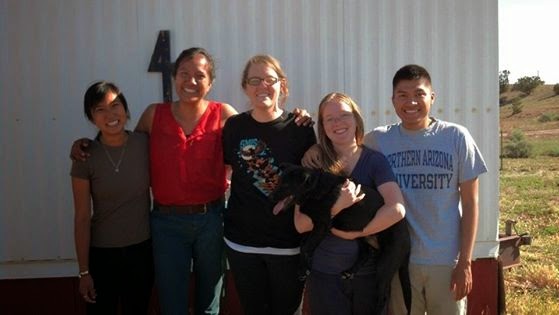
Welcome to Martha Hughes, who joins our staff in New Mexico, as one of our two Navajo Nation Outreach Coordinators.
This year we our expanding our capability on the Navajo Nation in Arizona and New Mexico in order to reach more schools.
Martha will be helping students at various schools prepare for the ACT, and will assist them with the college application process.
Martha grew up on the Navajo Nation in Shiprock, New Mexico. After receiving her BA in English & German from Coe College and her MA in Intercultural Education, Migration, and Multilingualism from the Karlsruhe University of Education, she's thrilled to be back in Dinétah. Reader to Reader affords her the unique opportunity to share her dedication to providing progressive education to Native youth through the Blueprint for Success program.
Our expansion of our Navajo Nation work is made possible by the generous support of the Fordham Street Foundation, the Hiatt Family Foundation, and Lynn and Jean Miller.
Monday, July 31, 2017
Reader to Reader Receives 5-Year Grant to Expand Navajo Nation Work
We are jumping for joy over our new 5-year capacity building grant we received to expand our work with Native American high school students on the Navajo Nation in Arizona and New Mexico.
The grant will enable us to hire an additional full-time staff person to be based in Fort Wingate, New Mexico.
Our goal is to expand the number of schools that participate in our Blueprint for Success program, which aims to raise college entrance exam scores, and guide students through the college admission process.
Last year, thanks to the program, students at Wingate High School in Fort Wingate scored 30% higher on their ACT exam than the students that attended the school in 2010-2014.
We gratefully thank the Fordham Street Foundation for the funding of this grant.
Tuesday, April 4, 2017
ACT Scores Soar at Wingate High
Reader to Reader’s Navajo Nation Outreach Coordinator, Jeannette Ortega, has been doing an amazing job at Wingate High School in Fort Wingate, New Mexico.
She teaches 6 classes a day focusing on ACT test prep and college readiness.
The results of her hard work are clear, as ACT scores have soared 30 percent since she arrived there two years ago.
The dramatic rise in scores makes more students eligible for college, and makes college more affordable, as more students are eligible for scholarships.
Thursday, November 12, 2015
Meet Jeanette Ortega, Reader to Reader Navajo Nation Outreach Coordinator
Reader to Reader’s amazing Navajo Nation Outreach Coordinator Jeannette Ortega helps high school students on the Navajo Nation prepare for ACT/SAT tests, college applications, and making the transition to college life. Here she is in her classroom at Wingate High School, Ft. Wingate, New Mexico.
Reader to Reader’s work on the Navajo Nation is funded in part by the Fordham Street Foundation, Lynn & Jean Miller, and the Hiatt Family Foundation.
This our fourth year having a full-time staff person based on the Navajo Nation, and just like the Outreach Coordinators that preceded her, Jeannette is doing a spectacular job of helping students prepare for college.
Jeanette is a 2015
graduate of Amherst College, and previously worked as a summer intern for Reader to Reader
in 2014.
Monday, February 23, 2015
St. Michaels Students Take College Discovery Class
Meg Holladay, our hard-working Navajo Outreach Coordinator, is teaching a College Discovery class at St. Michael Indian School in St. Michaels, Arizona.
Pictured above are students practicing a full-length practice ACT exam Reading section. Test scores have improved dramatically thanks to her work.
The Navajo Outreach
Program is funded in part by the Fordham Street Foundation and the Hiatt Family
Foundation.
Wednesday, December 3, 2014
Practice Makes Perfect at St. Michael Indian School
On Nov. 22, 12 students came to St. Michael's Indian School in St. Michaels, Arizona, on a Saturday morning to take a full-length practice ACT under the watchful eye of Reader to Reader’s Navajo Outreach Coordinator, Meg Holladay. We started bright and early at 8AM, the same time the real ACT begins, and the students worked hard on the test until around noon. Eight students chose to write the optional essay section of the test. After time was up, we graded the practice tests together. Students were able to compare their scores to the national averages, and see which sections were going well for them and which they needed to improve. Many told us it was a valuable experience for them, and everyone went home to a well-deserved weekend of rest!
Monday, November 10, 2014
St. Michael Students Learn About College Through Panel Discussion
Last week at St. Michael High School in St. Michaels, Arizona, our Navajo Outreach Coordinator, Meg Holladay, organized a panel discussion of five teachers talking about their experiences in college. This was part of Blueprint for Success, a college-exploration activity that Reader to Reader is running at SMHS.
Students are very
curious about college: what's it like to be there? Are professors mean? Is it
hard to live with a roommate? Through this panel, teachers were able
to tell their college stories. About 25 students, mostly juniors,
came during their lunch period to hear them.
The teachers who
volunteered to be on the panel had all had very different college
experiences. They had attended Penn State, Notre Dame, the University of New
Mexico, New Mexico State and the University of Colorado, and Georgian Court
University (a small women's college in New Jersey). They had majored in fields
as diverse as biology, English, education, and the history of ideas.
Here is Meg’s report
on the discussion.
I asked the teachers
four questions:
How did you choose
your college? When you got there, was it the way you expected?
One teacher said she
hadn't expected to like a women's school, and her heart had been set on another
college, but when she visited Georgian Court, it felt like a family and
she fell in love.
What part of college
was the hardest for you, and what was the most fun?
As the hardest part of
college, several teachers mentioned social life: getting to know a new set
of people, making friends, a divide between Native and non-Native students
at UNM. Another teacher talked about trying to balance academics and social
life. One teacher said that the intellectual exploration he did in college was
the most fun part; another mentioned an English majors' club that organized
events like bonfire poetry readings, and another talked about being a mentor
for younger students.
What was your single
favorite class and why?
One teacher said that
her hardest biology class in college, a class in which she'd spend whole days
studying, was also her favorite. Several students were incredulous that her
favorite was such a hard class. Another teacher told the students about a
child-development class in which he was the only man, and many of the women in
the class were his grandmother's age--he said he got in touch with the part of
himself that says "awww" at pictures of babies.
What part of college
has most impacted your life today?
One teacher talked
about the writing skills he gained, and how they've been applicable in many
more places than he thought they would be. Others talked about social and
intellectual skills.
Then we opened up the
discussion to student questions. Students asked the teachers what they had
written their application essays about, how much writing they had had to do in
college, and what they had been afraid of that had turned out okay.
I think that everyone,
including myself, left with a better idea of the range of experiences a person
can have in college.
Thursday, October 9, 2014
At Work on the Navajo Nation
We are so pleased to welcome Carleton College graduate Meg Holladay as
our new Navajo Outreach Coordinator.
Meg is based on the Navajo Nation in St. Michaels, Arizona, where she is bringing
a host of services and programs to area schools.
Through our Blueprint for Success Program, she is helping students with
ACT and SAT test prep, college search, college applications, essay writing, and
financial aid support.
She is also a resource connector, helping Reader to Reader meet the needs
of a wide variety of groups across the 27,000 square-mile Navajo Nation.
Friday, July 11, 2014
Reflections
Two
years ago, David Mazor dropped me off three hours west of Albuquerque, a mile
and a half up in the high desert. It rained that evening. It was quiet, and the
air smoldered with the smell of sage. I'd asked David a hundred times that
summer what I would do here. He said that I'd find out when I came. I'd listen
and I'd know.
To my last day, I
couldn't really tell you what my job was. My business cards say "Navajo
Nation Outreach Coordinator." I didn't know that I'd:
- witness a dozen
students improve their creative writing through our weekly Writers' Workshop
meetings and celebrate their progress with a year-end, well-attended CoffeeHaus
- raise average
school-wide ACT scores from 25% below NM and AZ state averages to above state
and national averages
- watch an endless
stream of books and resources from Reader to Reader fill classrooms and
libraries
- travel around the
Navajo Nation with the Office of the First Lady to deliver college readiness
materials and addresses
- work with the
incredible board of the Miss Navajo Council, an organization that mobilizes
former pageant winners to give back to their communities
- learn to make frybread
(poorly)
- watch my freshmen grow
in their writing abilities and put together a magazine of their work
- prepare my shyest
students for scholarship interviews
- take the Writers'
Workshop to hear writing advice and performances by Luci Tapahonso, Navajo
Nation Poet Laureate
- see 97% of SMIS' class
of 2014 go on to college
- grow to love those
seniors like my own siblings
- and be heartbroken to
see them go
... and much more.
My last two years with Reader
to Reader won't be my last in the Navajo Nation. Through working with Reader to
Reader, I've become interested in ethical, efficient management. This fall, I'm
headed to the Yale School of Management to get an MBA with a focus on social
enterprise and nonprofit management. After my program, I plan to return to the
reservation and work on a project to improve food sovereignty. There - now that
I've said it, all of you can hold me accountable.
This post is more about
me than I would've liked. Still, it's hard to extricate myself from my last two
years. On some level, I want to talk strictly about the honor it has been to
represent Reader to Reader in what has become my surrogate home, and what more
we could watch unfurl and progress. But that wasn't all. It hasn't become a
home because of improved statistics and partnerships formed. We shared a
mission, and we fought for it, and we grew to love and respect each other because
we did our best to listen. After all, that was my first instruction on the job.
The Navajo Nation is
often characterized by poverty and hardship, but that's merely one facet of a
diamond. I'm learning to listen, and in these last two years, that listening
has allowed me to witness the intense dedication and talent of others, and to
learn more than I thought possible. Every day, I'm humbled anew.
On my last night, my
friends and I slept on the roof of our trailer. We had unexpected company -
friends from over the hill. They talked, and we listened. We talked, and they
listened. It grew late, and wind rattled the brush. Our dogs howled and took
off across the field, and the cows lowed. A mile and a half closer to the
stars, am I any closer to hearing supernovae? Three hours west of Albuquerque,
does the universe seem silent, or can I incline my heart to the glory of stars
being born, of giants rising, of light unceasing to illuminate the darkest
corridors?
--Ophelia Hu
Thursday, March 27, 2014
Native American Students Explore Goal Setting
Ophelia Hu, Reader to Reader's Navajo Nation Outreach Coordinator, writes about the work she is doing with 50 freshmen and sophomores from the Kinlani all-Native dorm of Flagstaff High School in Flagstaff, Arizona. It is 369 miles round trip but that has not deterred her in the least.
I asked my audience if anyone could jump ten feet in the air. A few giggles, but no one raised any hands. I then asked if anyone could climb a flight of stairs. Goal setting is just like that.
Each student started by recalling and writing a long-term goal they had met in the past. One student won a local skate competition. One student won first place at the regional science fair. One student learned to do a crossover in basketball. The group had a wide range of accomplishments and techniques for arriving at their respective achievements.
We then planned steps to achieve long-term academic or extracurricular goals: what can we do today to bring us closer to achievement? What can we do in the next week? In the next month? How about in a month or in six months?
By dissecting large, seemingly impossible feats into manageable daily or weekly goals, lofty dreams become daily victories. Sometimes the greatest encouragement toward success is success. I also asked students to find at least one person in the room to lean on for accountability and encouragement.
While positive thinking and inspirational quotes can be helpful for the psyche, the athletes, musicians, siblings, and scholars in the auditorium all knew that achievement was ultimately the result of understanding why a goal is worthwhile and how it can be attained.
In a month, I will check with these students to chart the progress of their goal setting and achievements. During that presentation, we’ll talk about habits and tools for high school success.
Reader to Reader’s Navajo Outreach Coordinator is funded through the generous support of the Fordham Street Foundation, the Hiatt Family Foundation, and Jean and Lynn Miller.
Wednesday, February 26, 2014
Navajo Students Explore Writing at Indigenous Book Festival
Ophelia Hu, Reader
to Reader’s Navajo Nation Outreach Coordinator, writes about the exciting field trip
her students from St Michaels, Arizona took last week.
Last Friday, the extracurricular Writers’ Workshop of St.
Michael Indian School (SMIS) attended the Indigenous Book Festival at the
University of New Mexico in Albuquerque. This year’s festival focus was
“Authenticity and Indigeneity.”
Nine of the most dedicated Writers’ Workshop attendants were
selected to challenge their abilities, improve their writing skills, and learn
from masters of the craft.
After a three-hour morning journey, our day began with a
high school writing panel, in which the SMIS students had the full attention of
two MFA instructors from the Institute of American Indian Arts in Santa Fe and
learned valuable techniques for both poetry and prose-writing. One instructor
marveled that our students had honed such unique voices.
After the writing panel, the students and I had the honor of
listening to a presentation and poetry recitation by Chamoru poet Craig Santos
Perez, who wrote on food colonization in Guam. Craig’s concerns reflected a
similar food current in the Navajo Nation and many other reservations, and our
students appreciated his great performance.
In the afternoon, we split into four panels depending on our
interests, ranging from spiritual healing in literature to interviews of famous
poets (including the first Navajo Poet Laureate Luci Tapahonso) to weaving
cultural histories into modern narratives.
These young writers have now spent months honing their
crafts. This is some students’ second year in Writers’ Workshop. Through their
time, they’ve each better crafted the vehicle through which they tell their
stories, share their experiences, and relay their hopes. The maturity with
which they do so astounds me, and every piece I have the honor of reading or
hearing leaves me humbled.
And then, all along the long drive home through the dark, a
few girls sing in unison to a One Direction song; howls of laughter come after
a silly joke; they learn what hummus and couscous are; they dance in their
seats and dream of decorating the dorm rooms they’ll occupy next year. And I
remember that, despite all their maturity and potential and talents, they’re
still children – incredible children.
(Reader to Reader’s Navajo Outreach Coordinator is funded through the generous support of the Fordham Street Foundation, the
Hiatt Family Foundation, and Jean and Lynn Miller.)
Tuesday, February 11, 2014
Reader to Reader Helps ACT Scores Improve on the Navajo Nation!
Ophelia Hu, Reader to Reader's Navajo Nation Outreach Coordinator, describes the process of teaching SAT prep to seniors at St Michael’s Indian School this year.
We began class ten chairs short and in stifling heat last August in St. Michaels, Arizona. Our task: to improve the ACT scores of St. Michael Indian School's entire senior class with only 250 minutes per week.
For our second year in a row, ACT scores at St. Michael have remained over 1% above the national average, which is a drastic improvement from its standing of over 25% below that average before Reader to Reader began its College Readiness programs at the school.
But the applause certainly doesn't belong to Reader to Reader alone. The accolade belongs to the senior class, who toiled every day, attended optional practice tests in the evenings and on weekends, and achieved impressive personal score improvements. Reader to Reader also provided each student with a free, new copy of an ACT textbook, and both instruction and homework helped students to excel on the test.
I had the privilege of getting to know the remarkable Class of 2014. We worked hard. Not every day was fun. From time to time, students would call in the middle of the night asking for clarification with a concept or to vent about test anxiety. But between recovering math skills and summarizing dense science articles, we had our share of good times, too.
At the end of the course, each senior wrote a letter to the Class of 2015 with their personalized advice for senior year, college readiness, and ACT prep.
The continued success of students at St. Michael shows that all students have a remarkable capacity to grow and learn. We are honored to be a part of that process, and we look forward to getting even more students to take the reins on their future.
Reader to Reader’s Navajo Outreach Coordinator is funded through the generous support of the Fordham Street Foundation, the Hiatt Family Foundation, and Jean and Lynn Miller.
Subscribe to:
Posts (Atom)